
Innovation Resource Guide: Developing your Elevator Pitch
What is an 'Elevator Pitch' and when would I use it?
An elevator pitch is a short, persuasive summary (usually 30–60 seconds) that explains:
- Who you are
- What you do
- Why it matters / what makes you unique
- What you want next (a call to action, like a meeting or collaboration)
It’s called an elevator pitch because it should be brief enough to deliver during a quick elevator ride — concise, memorable, and engaging. You’d use an elevator pitch in situations where you need to quickly introduce yourself or your idea and spark interest. Common scenarios include:
- Networking events – Meeting new contacts and leaving a strong impression.
- Job interviews – Answering “Tell me about yourself” in a focused way.
- Client meetings – Explaining your services or value proposition quickly.
- Investor pitches – Summarizing your project or startup to potential backers.
- Casual encounters – Anytime someone asks “So, what do you do?”
- LinkedIn/social media introductions – Explaining why you are reaching out to connect.
Step by step guide to writing your pitch:
The below guide follows a five step approach to developing your elevator pitch. If you can nail all five of the below points your off to a great start!
1. Define your Core Message
Start by considering what the core message is that you are trying to convey:
- Who you are: Start with your name and role/ job title.
- What you do: Summarize your expertise or product in one sentence.
- Why it matters: Highlight the unique value or impact you bring.
2. Structure Your Pitch
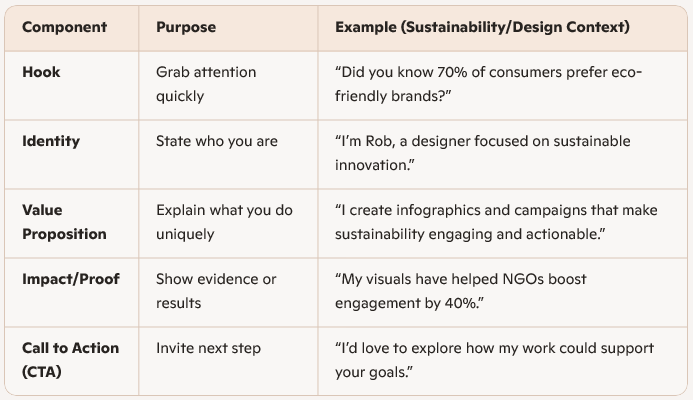
A strong elevator pitch usually follows this flow – this is expanded further in the table below:
- Introduction – Who you are – if you wish you can use an attention grabbing hook here before introducing yourself (as per the below example).
- Problem/Need – What challenge you address.
- Solution/Value – How you solve it uniquely.
- Impact/Proof – Evidence or results.
- Call to Action* – Invite engagement (e.g., “I’d love to share more over coffee”)
3. Keep It Short
Remember it’s an elevator pitch – if you can’t describe your product or service in less than a minute you don’t understand it well enough!
- Aim for 50–200 words or 30–60 seconds.
- Avoid jargon; use simple, memorable language.
4. Tailor to Your Audience
You should always have more than one elevator pitch ready to go depending who you’re talking to – it should be like a CV, tailored to the specific requirement, and you should be equally comfortable explianing your idea to a 5 year old, or a potential investor:
- Adjust depending on whether you’re speaking to investors, employers, or collaborators.
- Emphasize what’s most relevant to them
5. Practice & Refine
Practice makes perfect!
- Rehearse until it feels natural, not scripted.
- Test with peers and refine based on feedback.
Elevator Pitch Framework:
The following table breaks down a very simple elevator pitch into five constituent parts, this example uses Rob, a hypothetical graphic designer who focusses on the sustainability sector:
Pitfalls to Avoid:
If you take just one thing from this guidance (well three things…) make it these:
- Overloading with detail – Stick to essentials.
- Sounding generic – Avoid clichés like “hardworking” or “team player.”
- No clear ask – Always end with a next step (meeting, call, demo).
How should I tailor my pitch?
There are generally four different style of pitch – and each one should be focussed slightly differently. While the content will largely remain similar, the emphasis should differ depending on the audience:
- Networking: Keep it light, focus on passion and connection.
- Clients: Emphasize results and services.
- Investors/Partners: Highlight alignment with global frameworks and measurable impact.
- Casual: Use when time is tight or in informal settings – keep it short, snappy and you guessed it, casual.